
Spousal Maintenance (Alimony)
What Is Alimony? A Guide to Spousal Support
Alimony—also called spousal support or spousal maintenance—is money one spouse may be ordered to pay the other during or after a divorce. It is not automatic. Courts generally look at one spouse’s financial need, the other spouse’s ability to pay, the length and circumstances of the marriage, and the law of the state handling the case.
How does alimony work?
Alimony is a financial-support arrangement between current or former spouses. Depending on the state and stage of the case, it may be created through a negotiated agreement or ordered by a judge. Payments are commonly made monthly, although spouses may sometimes agree to a lump-sum payment or another structure allowed by local law.
The purpose is not to punish either spouse or automatically equalize their incomes. Instead, support can help a lower-earning spouse meet reasonable needs, adjust after the marriage, obtain education or job training, or maintain an appropriate standard of living when the law and facts support an award.
What are the different types of alimony?
States use different labels, and not every state recognizes every category. Most support arrangements fall into one or more of the following groups:
Temporary support
Support paid while a divorce or legal-separation case is pending. It may help cover housing, food, insurance, and other ordinary expenses until final orders are entered.
Rehabilitative support
Time-limited support intended to help a spouse become more self-sufficient through education, training, credentialing, or a return to the workforce.
Transitional or short-term support
Support designed to ease the financial move from married life to separate households, often for a set period following divorce.
Long-term support
Support that may continue for a substantial period when a long marriage, age, health, caregiving history, or a major earning disparity makes near-term self-sufficiency unrealistic.
Reimbursement support
In jurisdictions that recognize it, support may compensate a spouse whose financial or household contributions helped the other spouse obtain education, training, or increased earning capacity.
Contractual support
Spouses may negotiate support in a marital agreement or divorce settlement. Contractual terms can differ from what a court could independently order, subject to state law.
The word “permanent” can be misleading. Even long-term support may end or change after remarriage, death, a substantial change in circumstances, or another event specified in the order.
Who may qualify for alimony?
There is no universal rule that a spouse receives alimony after a certain number of years. Eligibility is highly fact-specific. A spouse seeking support generally needs to show a financial need recognized by state law, while the other spouse must have the ability to contribute after meeting their own reasonable needs.
Situations that may support an alimony request
- One spouse left the workforce or reduced work to raise children or manage the household.
- There is a substantial difference in income or realistic earning capacity.
- A spouse needs education, licensing, or job training to return to appropriate employment.
- Age, disability, or health limitations affect a spouse’s ability to become self-supporting.
- A long marriage created significant financial dependence or an established marital lifestyle.
- One spouse contributed to the other spouse’s career, business, or professional education.
Myth The lower-earning spouse automatically receives alimony.
Reality A lower income can be relevant, but courts also evaluate need, ability to pay, statutory eligibility, property division, and other case-specific factors.
How is alimony calculated?
Alimony is not calculated by one nationwide formula. Some states publish advisory formulas or temporary-support guidelines, while others give judges broad discretion. Even where a guideline applies, the court may need to make findings about whether the resulting amount and duration are fair under the circumstances.
Common factors courts consider
| Factor | Why it matters |
|---|---|
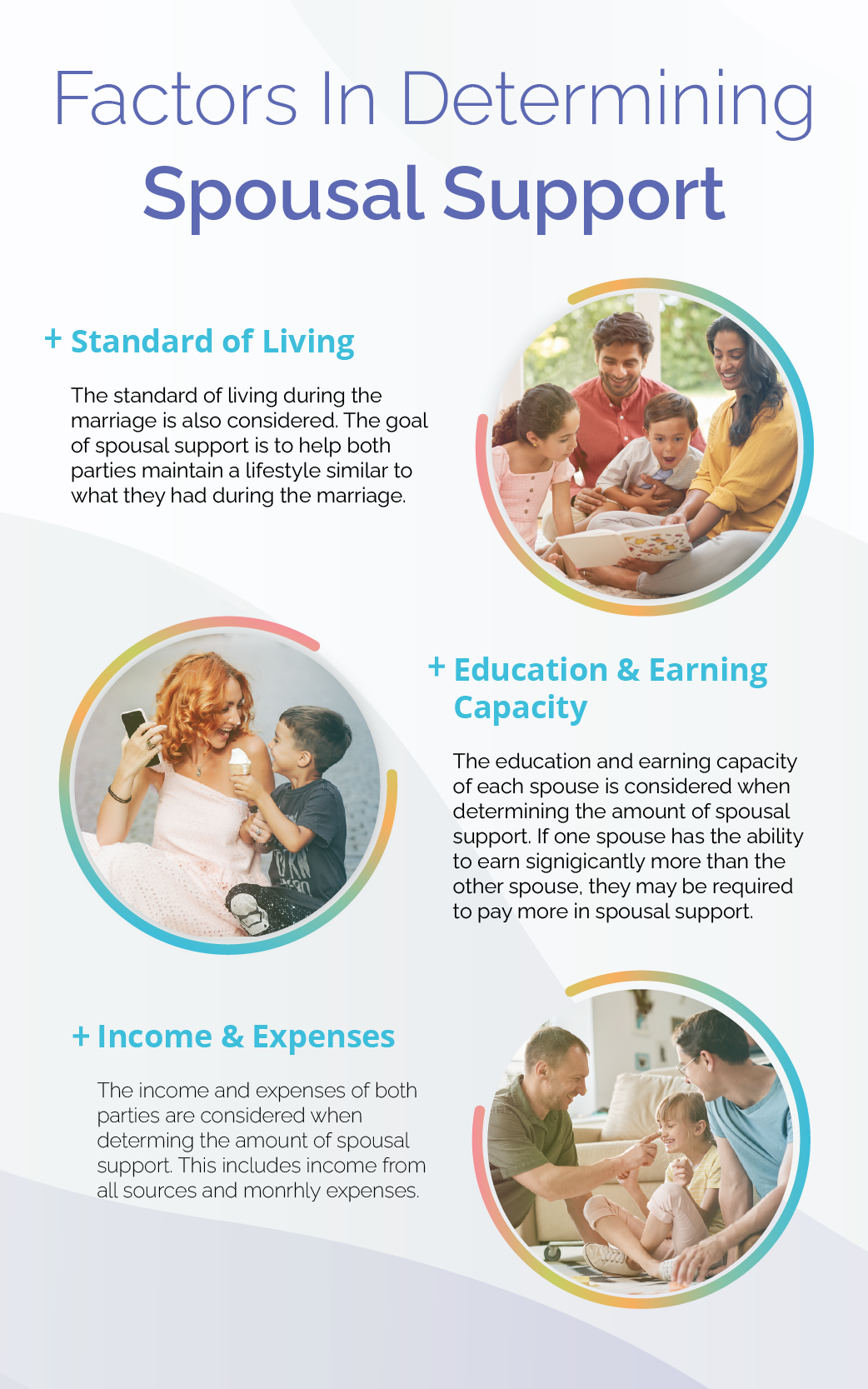
| Income and financial resources | Courts compare earnings, assets, debts, benefits, and resources available after property division. |
| Earning capacity | Current income may not show what each spouse can reasonably earn with appropriate employment, education, or training. |
| Length of the marriage | Longer marriages may support longer awards, but duration alone does not guarantee support. |
| Marital standard of living | Some states consider the lifestyle established during the marriage, while recognizing that two households usually cost more than one. |
| Age and health | Physical or mental health conditions and proximity to retirement may affect employability and financial need. |
| Contributions to the marriage | Homemaking, child-rearing, career support, and contributions to education or a family business may be relevant. |
| Childcare responsibilities | A parenting schedule or a child’s needs may limit a spouse’s immediate ability to work full time. |
| Tax and other financial effects | Property division, insurance, retirement, and the tax treatment of payments can affect the practical result. |
An online estimate is not a court order
Calculators can provide a planning estimate, but they may not account for disputed income, bonuses, self-employment, unusual expenses, property division, statutory caps, or judicial discretion.
How long does alimony last?
The duration of alimony depends on the type of support, the length of the marriage, the recipient’s path toward self-sufficiency, and state law. Temporary support usually ends when the court enters final orders unless it is replaced by a post-divorce award.
Post-divorce support may last for a defined number of months or years, until a specified event, or—less commonly—for an indefinite period subject to future review or modification. Courts frequently aim for the shortest period that reasonably addresses the legally recognized need, but each jurisdiction approaches duration differently.
Key takeaway
Marriage length is important, but it is not a universal stopwatch. Two marriages of the same duration can produce different outcomes because the spouses’ finances, health, employment histories, property awards, and state laws are different.
How alimony laws differ by state
Alimony is controlled primarily by state law. The comparison below is a high-level overview of the states where Modern Family Law currently practices; it is not a substitute for reviewing the statute and current case law that apply to a specific case.
Colorado
Colorado calls alimony maintenance. State law provides advisory guidelines in qualifying cases, but the court retains discretion and must determine whether an award is fair and equitable. Colorado courts consider financial resources, reasonable needs, income, employability, marriage length, age, health, and significant economic or noneconomic contributions.
California
California distinguishes temporary support during the case from long-term support after judgment. For long-term support, courts consider multiple statutory factors, including the marital standard of living, earning capacity, marketable skills, contributions to education or career development, needs, assets and obligations, marriage duration, age, health, documented domestic violence, and tax consequences.
Texas
Texas court-ordered spousal maintenance is more limited than support in many states. A spouse must satisfy statutory eligibility requirements, and Texas generally directs courts to limit maintenance to the shortest reasonable period. Separate from court-ordered maintenance, spouses may negotiate contractual alimony.
Washington
Washington courts may award spousal maintenance in an amount and for a period the court finds just after considering factors such as the spouses’ financial resources, time needed for education or training, marital standard of living, marriage duration, age and health, and the paying spouse’s ability to meet both parties’ needs.
Georgia
Georgia may award temporary or permanent alimony based on one spouse’s needs and the other spouse’s ability to pay. Courts may consider the marital standard of living, marriage duration, age and health, financial resources, time needed for education or training, contributions to the marriage, and each spouse’s financial condition.
Can alimony be changed or terminated?
Sometimes. Whether support can be modified depends on the order, the spouses’ agreement, and state law. A material change in income, employment, health, or financial need may justify a request to modify support, but the existing amount normally remains enforceable until the court changes it.
Events that may affect alimony
- A substantial and continuing change in either spouse’s income or expenses
- Job loss, retirement, disability, or a major health change
- The recipient’s remarriage or, in some states, qualifying cohabitation
- The end date or review date stated in the order
- The death of either spouse
- A nonmodifiable support agreement permitted by state law
Is alimony taxable?
For most divorce or separation instruments executed after December 31, 2018, alimony is generally not deductible by the payer and is not included as taxable income by the recipient for federal income-tax purposes. Older agreements and later modifications can require a closer review, and state tax treatment may differ. A family-law attorney and tax professional can help evaluate the specific order.
What information helps evaluate an alimony claim?
A clear financial record helps both spouses understand the likely issues and negotiate from reliable information. Useful documents may include:
- Recent pay stubs, tax returns, W-2s, 1099s, and benefit statements
- Business records and profit-and-loss statements for self-employed spouses
- A realistic monthly budget for each separate household
- Bank, investment, retirement, and debt statements
- Health-insurance and anticipated medical expenses
- Employment history, education, licenses, and job-market information
- Evidence of childcare duties and contributions to the other spouse’s career
FAQ + Structured Data Test
Frequently asked questions about alimony
These answers provide general information. State law and the facts of a particular marriage control the outcome.
What is alimony, and why is it awarded?
Alimony is court-ordered or agreed financial support paid by one spouse to the other during or after divorce. It may be awarded to address a legally recognized financial need or economic imbalance when the other spouse has the ability to pay.
What are the different types of alimony?
Common categories include temporary support while a case is pending, rehabilitative or transitional support for a limited adjustment period, and longer-term support in appropriate cases. Some states also recognize reimbursement support, while spouses may be able to create contractual support through an agreement.
How do courts calculate alimony?
Courts commonly evaluate each spouse’s income, expenses, financial resources, earning capacity, age and health, the marriage’s duration and standard of living, contributions to the household, and the paying spouse’s ability to pay. Some states use advisory guidelines, but there is no single nationwide formula.
How long does alimony last?
Alimony may last only while a divorce is pending, for a fixed post-divorce period, until a specified event, or—less commonly—for an indefinite term. The duration depends on state law, marriage length, financial need, earning capacity, and the purpose of the award.
Can alimony be modified or terminated?
Alimony can often be modified after a substantial change in circumstances, unless a valid agreement or order makes it nonmodifiable. It may also end on a stated date or after events such as remarriage or death, depending on the governing law and order.
Does cheating affect alimony?
It depends on the state. Some states generally decide support without considering marital misconduct, while others permit certain misconduct—including adultery—to affect eligibility or the amount awarded. The financial facts and the specific state statute remain critical.
Do you have to be married for 10 years to receive alimony?
No universal 10-year rule exists. Marriage length can affect eligibility or duration, but courts also consider financial need, ability to pay, earning capacity, health, property division, and state-specific requirements.