


Licensed Legal Paraprofessionals
Empowering Your Career Journey
If you’re a dedicated paralegal in Colorado looking to take your career to the next level, we invite you to embark on a transformative journey by becoming a Licensed Legal Paraprofessional (LLP) with MFL.


Licensed Legal Paraprofessionals in Colorado
The Colorado Supreme Court has approved the licensure of legal paraprofessionals in a new rule that is designed to make legal representation more widely available and more affordable to people in certain domestic-relations matters.
Licensed Legal Paraprofessionals (LLPs) may file court documents representing their clients in mediation during domestic cases involving divorce proceedings and child custody hearings. LLPs will also be able to accompany clients to court and answer a judge’s questions but will be unable to present oral arguments or question witnesses. Learn about Licensed Legal Paraprofessionals in Colorado below including:
What Is a Licensed Legal Paraprofessional?
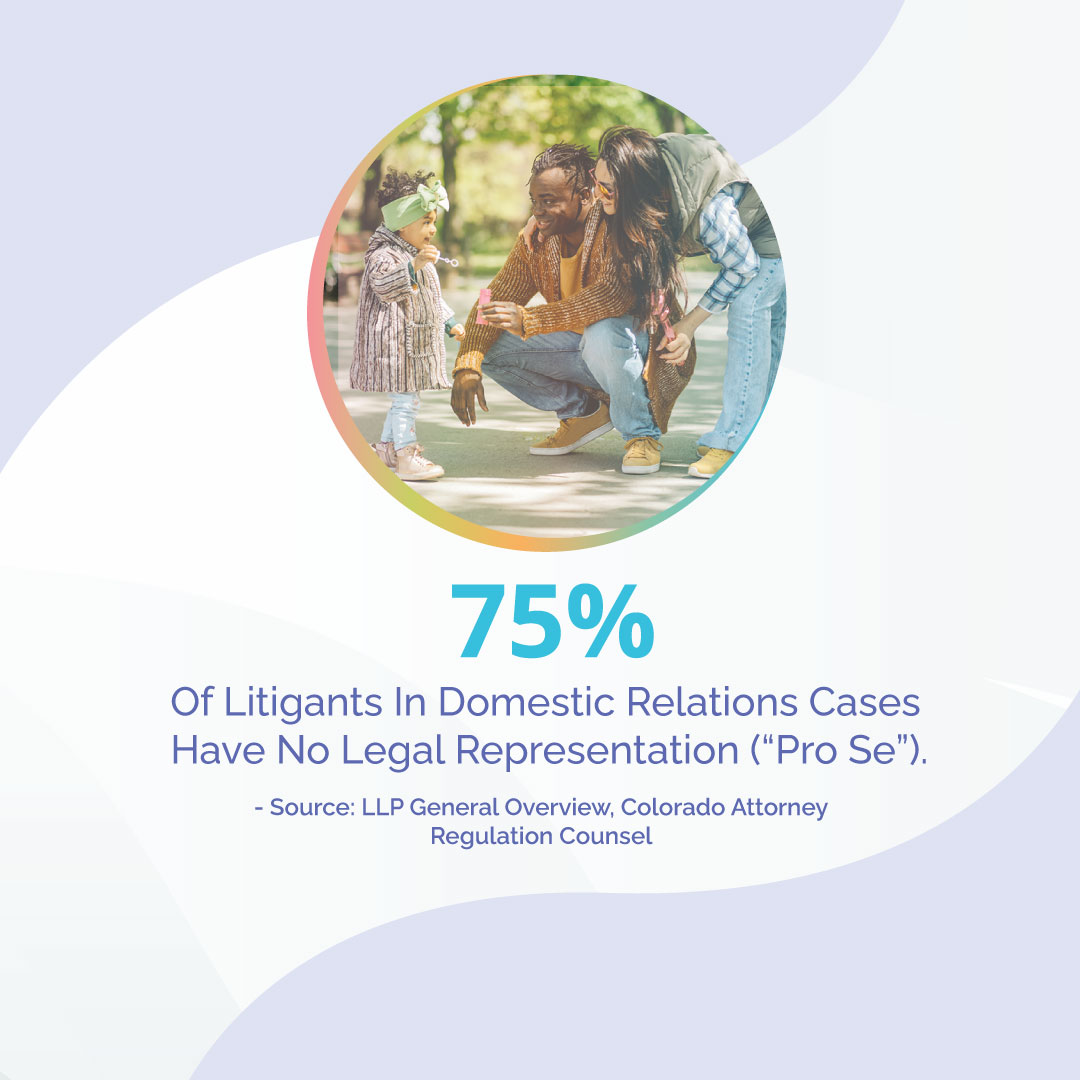
The Colorado Supreme Court has ruled that licensed legal paraprofessionals without law degrees will be able to offer client representation in specific situations. This move aims to address the representation gap, particularly in cases involving limited marital assets, parentage, and allocation of parental responsibility (APR). These legal paraprofessionals (LLPs) are authorized to directly assist clients, attend court alongside them, and respond to inquiries from judges. However, their role is restricted from making oral arguments or questioning witnesses. By taking this step, the state Supreme Court anticipates enhancing the accessibility and affordability of legal representation.
What Responsibilities Can a Colorado LLP Undertake?
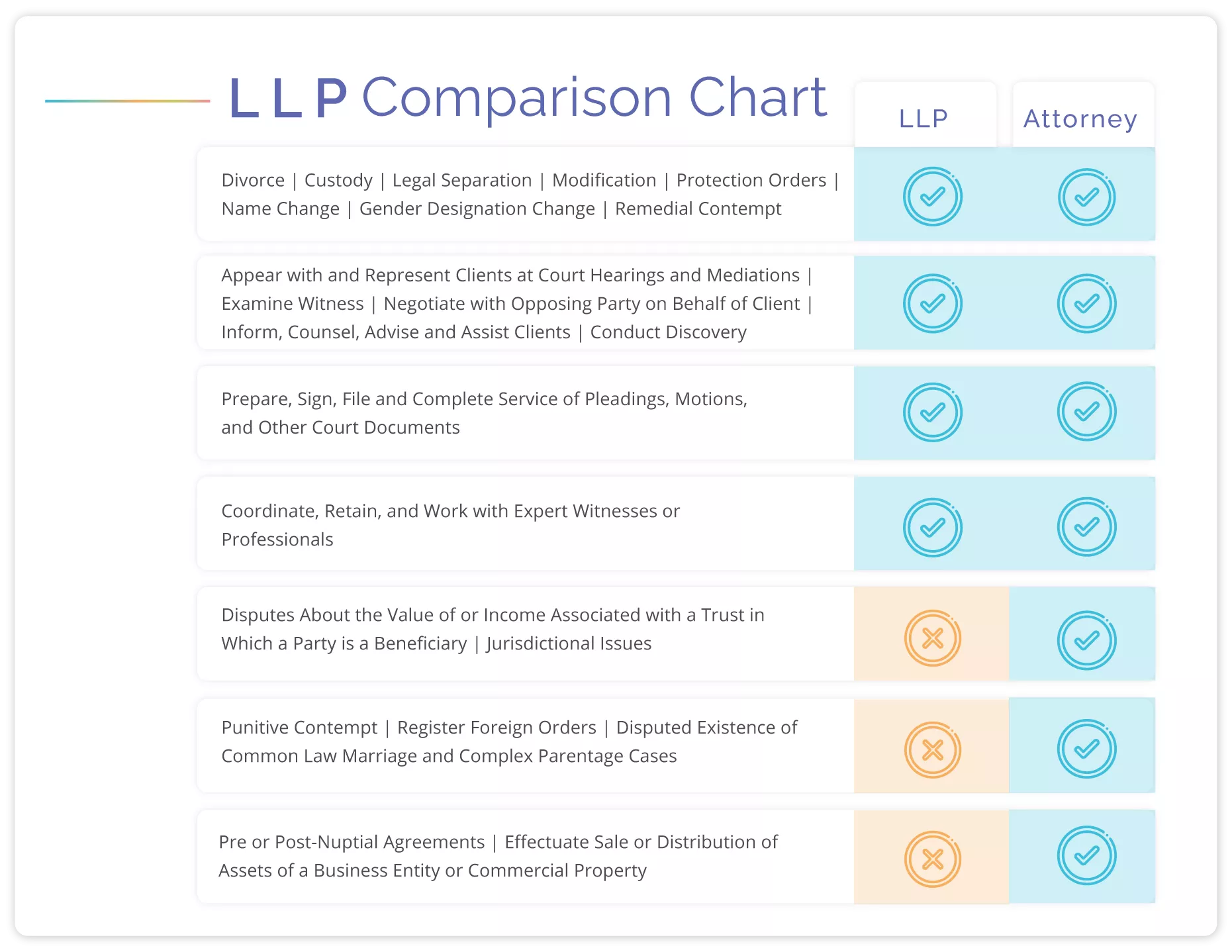
Although an LLP doesn’t possess all of the capabilities of a lawyer, this new Colorado rule outlines many tasks that can be handled by Licensed Legal Paraprofessionals. Rule 207.1(2)(g) explains these new responsibilities including:
- Establishing a contractual relationship with a client (Subsection i).
- Conducting client interviews (Subsection ii).
- Providing guidance to clients on the usage of Colorado’s standard court forms and pleadings (Subsection iii).
- Completing the aforementioned standard forms (Subsection iv).
- Explaining and submitting documents in support of the standard court forms (Subsection v).
- Managing document filing and service (Subsection vi).
- Reviewing and explaining pleadings from the opposing party or related to pension plans (Subsection vii).
- Engaging in negotiations on behalf of a client, including mediation (Subsection viii).
- Drafting and submitting settlement agreements (Subsection ix).
- Facilitating communication with the opposing party or attorney regarding documents (Subsection x).
- Maintaining communication with the client (Subsection xi).
- Clarifying court orders for clients (Subsection xii).
- Offering clients information about supplementary resources (Subsection xiv).
- Advising clients to seek legal representation for more intricate emerging issues (Subsection xv).
- Limited in-court involvement: “standing or sitting at the counsel table with the client during a court proceeding to provide emotional support, communicating with the client during the proceeding, answering questions posed by the court, addressing the court upon the court’s request, taking notes, and assisting the client in understanding the proceeding and relevant orders” (Subsection xiii).
Who Can Become a Colorado LLP?
In Colorado, becoming a Licensed Legal Paraprofessional involves meeting specific qualifications and fulfilling certain requirements to ensure a high level of competence and professionalism in the legal field. All applicants are mandated to successfully pass both a family law examination and a legal ethics examination administered by the Office of LLP Admissions of the Colorado Supreme Court. These exams follow the completion of a legal ethics course, which can be taken either as part of a degree program or as an independent course of study. Moreover, applicants must fulfill the stipulated character and fitness criteria and complete the professionalism course offered by the Office of Attorney Regulation Counsel.
Prospective candidates seeking eligibility to sit for the exams have several educational pathways and an experience-based option to consider. CRCP 207.8(3) enumerates five distinct types of degrees that qualify for eligibility. Irrespective of the degree type, all Colorado LLP applicants must additionally validate their accomplishment of 1,500 hours of practical experience in substantive law-related fields, with 500 hours dedicated to Colorado family law, within the immediate three years preceding the submission of their LLP application.
Applicants without qualifying degrees must demonstrate equivalence to three full-time years of substantive law-related employment, with at least one year focused on Colorado family law, within the five years immediately before applying. This mirrors the timing standard for degree holders: a combined 1,500 hours of practical experience, including 500 hours in Colorado family law, within the immediate preceding three years.
“Making it easier for people to secure legal representation in these often difficult matters has been a long-term goal of our commitment to ensuring access to justice for all Coloradans.
Allowing non-lawyers to provide limited legal representation for people who otherwise couldn’t afford it will not only help those litigants, but it will help the courts efficiently and effectively handle their cases.”
Allowing non-lawyers to provide limited legal representation for people who otherwise couldn’t afford it will not only help those litigants, but it will help the courts efficiently and effectively handle their cases.”
COLORADO SUPREME COURT CHIEF JUSTICE BRIAN D. BOATRIGHT
The Office of LLP Admissions will provide guidance regarding the manner in which applicants can substantiate their work experience eligibility. It is expected that validation from a licensed attorney affirming the completion of work experience will be mandatory for applicants.
Modern Family Law’s Support of Colorado LLPs
At Modern Family Law, we encourage and support our paralegals in Colorado to become LLPs. MFL believes that by actively participating in this initiative, we can not only enhance the quality of our legal services but also contribute to the broader goal of increasing access to legal representation for the communities we serve. Our firm’s dedication to this cause is a testament to our belief in continuous professional development and commitment to serving our clients with compassion.

Elevate Your Career with Modern Family Law
At Modern Family Law, we’re not just a law firm – we’re a community of driven legal professionals committed to growth, innovation, and making a lasting impact. If you’re a dedicated paralegal in Colorado looking to take your career to the next level, we invite you to embark on a transformative journey by becoming a Licensed Legal Paraprofessional (LLP) with MFL.
01
Empower Your Independence
As an LLP at MFL, you’ll experience newfound independence in your work. Take charge of your caseload, collaborate directly with clients, and play a hands-on role in providing crucial legal assistance. Your autonomy will be nurtured within a supportive environment that values your expertise.
02
Innovative Compensation Structure
We recognize the contributions of our LLPs with a compensation structure that rewards your dedication and the quality of your work. Your commitment will be acknowledged through competitive compensation that aligns with your growing responsibilities.
03
Exempt Employee
Embrace your role as an exempt employee, reflecting your elevated responsibilities and recognizing your dedication to delivering exceptional legal services. Enjoy the benefits of this professional distinction within a firm that values your commitment.
04
Invested Professional Growth
At MFL, we’re invested in your professional growth. That’s why we cover your registration and testing fees as you pursue your LLP status. We’re committed to supporting your journey every step of the way.
05
Ownership of Your Caseload
As an LLP at MFL, you’ll take ownership of your caseload, fostering your confidence and expertise. This ownership empowers you to have a direct impact on our clients’ lives and the legal services we provide.
06
Personalized Support
Your growth matters to us. As an LLP, you’ll have a Managing Attorney serving as your own mentor, ensuring personalized guidance, coaching, and continuous learning opportunities.
07
Collaborate Internally
Engage in meaningful collaborations with our experienced attorneys. As an LLP, you’ll have the valuable opportunity to consult with attorneys internally, expanding your knowledge and skills while enhancing the quality of the legal services we provide.

Join Us In Shaping the Future of Family Law Representation!
By embracing the LLP initiative at MFL, you’re not only propelling your own career forward but also contributing to a broader mission of increasing access to legal representation in our communities. Our commitment to this cause reflects our dedication to your growth and our clients’ needs. At MFL, we believe in the power of continuous professional development and serving our clients with unwavering compassion. Take the leap, and let’s create a transformative legal experience together.
VIEW OUR EMPLOYMENT OPPORTUNITIESFrequently Asked Questions About Licensed Legal Paraprofessionals in Colorado
What Will LLPs Be Prohibited From Doing?
C.R.C.P. 207.1 outlines the specific areas of legal practice in which an LLP is restricted from independently handling matters and services. In such instances, clients are either required to engage the services of a licensed attorney or manage the matter themselves. However, an LLP can still provide assistance in these situations while operating under the guidance and supervision of a licensed attorney.
Here is a comprehensive list of matters and issues that lie beyond the authorized scope of an LLP’s practice of law:
1. The registration of foreign orders.
2. Motions for or orders concerning punitive contempt citations under C.R.C.P. 107.
3. Cases involving allegations of common law marriage.
4. Situations involving contested parentage disputes with more than two parties asserting or denying legal parentage.
5. Matters where a non-parent’s request for allocation of parental responsibility (“APR”) is contested by at least one parent.
6. Preparation of, or litigation regarding, pre- or post-nuptial agreements.
7. Cases in which a party is a beneficiary of a trust, and information about the trust is relevant to resolving the matter.
8. Situations where a party intends to challenge the court’s jurisdiction over the matter.
9. Preparation by the LLP of a qualified domestic relations order (“QDRO”) or other documents allocating non-liquid retirement assets.
10. The preparation by the LLP of documents needed for the sale or distribution of assets involving business entities or commercial property.
11. Matters necessitating expert reports or testimony for valuing complex assets or determining income due to the intricacies of the asset or income involved.
12. Issues connected to, but directly influencing, a matter within the LLP’s scope of practice, when these issues require analysis and advice outside that scope. This includes immigration, criminal, and bankruptcy matters that could directly impact the resolution of the case.
How Will Clients Know If a Legal Professional Is an LLP or a Lawyer?
According to the ethics regulations for LLPs, it will be obligatory for licensed legal paraprofessionals (LLPs) to clearly indicate their status, including the fact that they possess a restricted license, in all forms of advertising. Additionally, LLPs will be expected to include the LLP designation in all submissions made to the court.
Moreover, LLPs will be required to undergo annual registration and adhere to the relevant continuing legal education criteria. Non-compliance with these obligations will lead to the administrative suspension of their licenses.
What Will It Cost To Become an LLP?
The expense associated with becoming an LLP will vary, taking into account an individual’s educational background and their ability to satisfy eligibility criteria through experience. However, all applicants will be subject to an application fee designed to offset the exam’s expenses, an annual registration fee, and specific costs related to ongoing legal education. Presently, the annual registration fee stands at $190 for the initial three years of practice, followed by $325 per year thereafter. The exact figures for other fees are yet to be determined.
